Papal Easter Message 2010 رسالة قداسة البابا لعيد القيامة المجيد
Papal Message
His Holiness Pope Shenouda III
Pope of
Alexandria
Feast of Easter April 4th, 2010
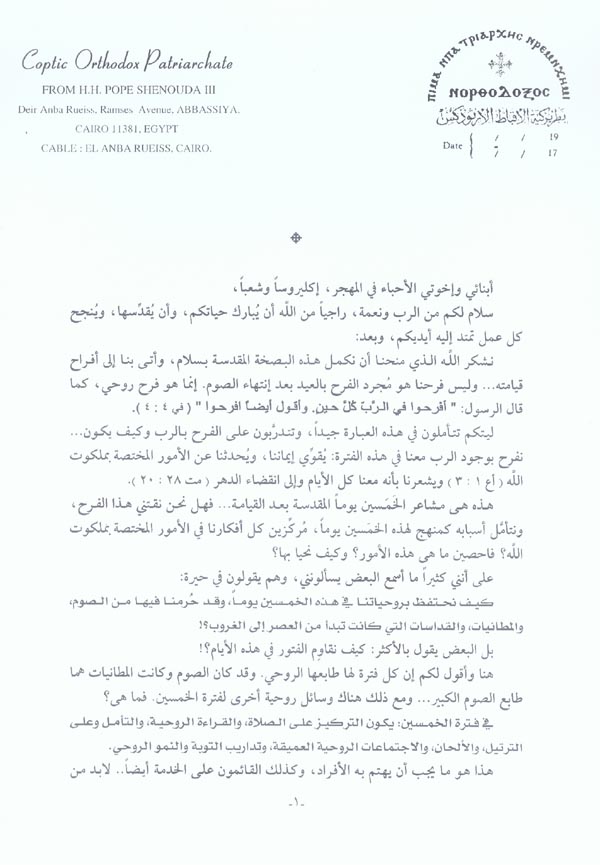
My beloved sons in the lands of immigration, priests and congregation.
Peace and grace from Our Lord, hoping that God may bless your lives and sanctify them and may every work that you do be successful. We thank God Who granted us to complete this Holy Pascha in peace and has brought us to the joys of His Resurrection. Our joy is not merely the joy of the Feast after ending the fast. Our joy however, is a spiritual joy, as the apostle said, "Rejoice in the Lord always. Again I will say, rejoice." (Philippians 4:4)
I wish that you meditate well on this phrase
and practice rejoicing in the Lord and on how it should be. We rejoice in
the presence of the Lord with us during this period, to strengthen our faith
and to speak to us about matters pertaining to the
These are the feelings of the holy fifty days
after the Resurrection. Do we have such joy and contemplate on its reasons
as a principle for these fifty days, focusing all our thoughts on matters
pertaining to the
I hear so often some people, whilst being perplexed asking me, how can we keep our spirituality during these fifty days when we have been deprived from fasting and prostrations during these days and also from the liturgies that begin in the afternoon and end at sunset? Whereas some say more than that, how can we overcome lukewarmness during these days? Here I say to you that every season has its own spiritual nature. Fasting and prostrations were the nature of the Great Lent. However, there are other spiritual means for the holy fifty days. What are they?
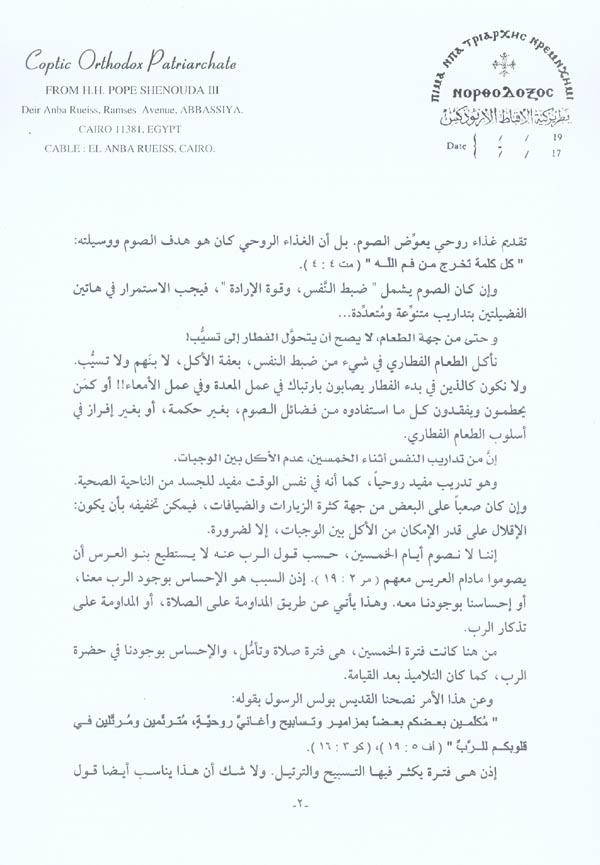
In the period of the fifty days, the focus is on prayer, spiritual reading, contemplation, praising and hymns, deep spiritual meetings, exercises of repentance and spiritual growth. This is what each individual as well as those who are responsible for the ministry should be concerned with. It is inevitable to present spiritual nourishment to take place of the fast. Spiritual nourishment was the aim and the means of the fast, "Every word that proceeds from the mouth of God." (Matthew 4:4) If fasting includes self control and strong will, we should continue in these two virtues with various and many exercises.
With respect to food, it is not appropriate to lose control when breaking the fast. We should eat with self-control and not with gluttony. We should not be like those who after breaking the fast cause upset to their stomachs, or those who destroy and lose all of the benefits of the virtues of fasting without wisdom or discernment by the way they eat. One of the exercises of self-control during the fifty days after Lent, is lack of eating between meals. It is a useful spiritual exercise, as it is at the same time useful for the health of the body. Whereas this may be difficult for some with respect to the many visits and banquets that they attend and host, this can be minimized by lack of eating as much as we can between meals, except when necessary.
We do not fast during the fifty days after
Lent according to the saying of the Lord, "can the friends of the bridegroom
fast while the bridegroom is with them?" (Mark
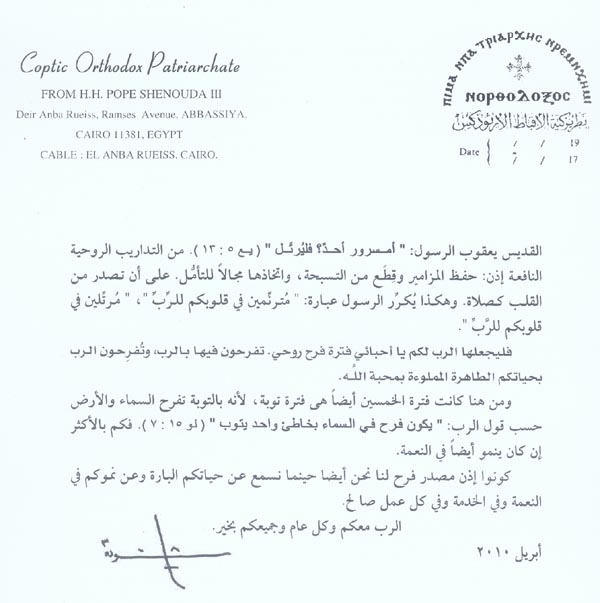
Through this, the fifty-day period after Lent is a period of prayer, contemplation and our feeling of being in the presence of the Lord, as were the disciples after the Resurrection. "Speaking to one another in psalms and hymns and spiritual songs, singing and making melody in your heart to the Lord." (Ephesians 5:19; Colossians 3:16) It is a period in which praising increases. There is no doubt that this also agrees with the saying of Saint James the apostle who said, "Is anyone cheerful? Let him sing psalms." (James 5:13) Some beneficial spiritual exercises are memorizing psalms and parts of praise and using them as an opportunity for contemplation, in order for them to originate from the heart as prayer. That is why the apostle repeats the phrase, "singing in your heart to the Lord" "making melody in your heart to the Lord."
May the Lord grant it to be a period of spiritual joy for you my beloved, in which you rejoice in the Lord and to make the Lord rejoice by your pure lives that are filled with God’s love. Hence, the period of these fifty days was also a period of repentance, since by repentance heaven and earth rejoice according to the Lord’s saying, "There will be more joy in heaven over one sinner who repents." (Luke 15:7) How much more so if he also grows in grace.
Therefore, be a source of joy to God, His angels and to heaven. Be also a source of joy for us when we hear about your righteous life, your growth in grace, ministry and in every good work. The Lord be with you and wishing you a happy Feast of the Resurrection.
Pope Shenouda III
The Feast of the Resurrection April 2010